-
Peptides
Peptides
-
- show all
-
- show all
-
Type
- show all
- 5-amino 1MQ
- ACTH 1-39
- Adamax
- Alarelin
- AOD-9604
- ARA 290
- ARG-BPC
- B7-33
- BPC 157
- Show more
- Bronchogen
- Cardiogen
- CJC-1295
- CJC DAC
- Cortagen
- DSIP
- Epithalon
- GC-1 SOBETIROME
- GHK-Cu – Glycyl-L-histidyl-L-lysine Supplement
- GHRP-2 – Growth Hormone Releasing Peptide
- GHRP-6 – Growth Hormone Releasing Peptide
- GLP-1 – Glucagon-Like Peptide Supplement
- GRF – Growth Hormone Releasing Factor Supplement
- HGH – Human Growth Hormone Supplement
- HGH fragment 176-191 – Human Growth Hormone Fragment 176-191 Supplement
- IGF-1 LR3 - Insulin-like Growth Factor-1 LR3 Supplement
- IGF DES – Insulin-like Growth Factor DES Supplement
- Ipamorelin
- Kisspeptin
- KPV
- Larazotide acetate
- Lipotropin
- LL-37
- Livagen
- L21
- Matrixyl
- Melanotan
- Melanotan 2
- Mots
- N-acetyl
- Oxytocin
- P-21
- Pancragen
- PEG-MGF
- Prostamax
- PT-141
- Retatrutide
- Selank
- Semax
- Sermorelin
- SLU-PP-332
- Snap 8
- TB-4 FRAG+BPC-157 ARG
- TB-500
- Thrombin peptide Tp508
- Thymogen Alpha-1
- Thymosin Alpha 1
- TRH
- Thymalin
- Thymosin
- VIP
-
- show all
-
Peptides - Bestsellers
- Sarms Sarms
- Amino acids Amino acids
- Nootropics Nootropics
-
Supplements
Supplements
-
- show all
-
- show all
-
Type
- show all
- 5-Hydroxytryptophan
- Ashwagandha
- Apigenin
- B-12
- Astragalus
- Berberine
- Biotin
- Cholinolytics
- Cordyceps
- Show more
- Magnesium citrate
- DIM
- Diosmin
- EGCG
- Forskolin
- Phosphatidylserine
- Glycine
- Inositol
- Canna
- Kava Kava
- Coenzyme Q10
- Collagen
- Curcumin
- Alpha lipoic acid
- Quercetin
- Lactoferrin
- Lion's mane
- L-Theanine
- Magnesium
- Magnesium l-threonate
- Magnesium taurate
- Sodium butyrate
- N-Acetylcysteine
- NAD+
- NALT
- Chasteberry
- Omega-3
- Panax ginseng
- Chromium picolinate
- Zinc picolinate
- PQQ
- Pycnogenol
- Reishi
- Resveratrol
- Rhodiola rosea
- Selenium
- Shilajt
- Synephrine
- Baikal Skullcap
- Tart cherry
- TUDCA
- Tulsi
-
- show all
-
Supplements - Bestsellers
- Cosmetics Cosmetics
- Diet & Sports Nutrition Diet & Sports Nutrition
- New New
- Accessories Accessories
- UNBREAKABLE UNBREAKABLE


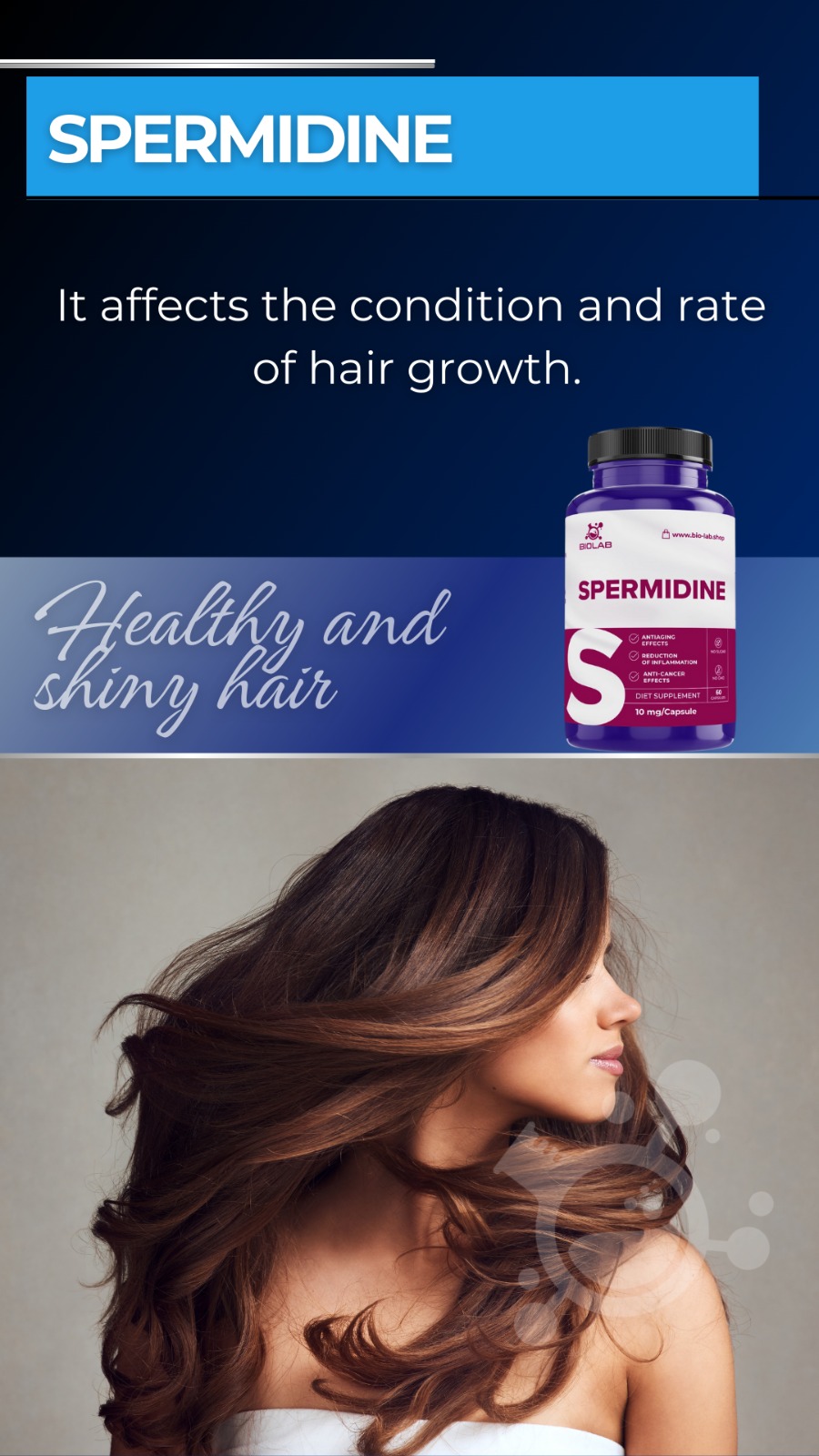
Spermidine 10 mg – complement for cellular balance and homeostasis
Spermidine is a polyamine that is naturally produced by the body and can be absorbed from food, but its levels decrease with age. It is involved in the formation of spermine from putrescine and S-adenosylmethionine - one of the stages of methylation in the human body. If your diet does not include a rich supply of products such as sprouts, spirulina, legumes, soya, whole grains or ripened cheese, it is definitely worth considering this product. It is also found in large amounts in male semen (sperm) and the central nervous system, particularly in the white matter of the brain.

Benefits:
• Supports the immune system
• Protects against oxidative stress
• Supports autophagy processes
• Influences cell growth and proper cell division
• Stabilises the structure of DNA and RNA
• Has an anti-ageing effect
Supports autophagy processes. Autophagy is the process by which cells remove and process damaged or malfunctioning molecules, which are then reused - in other words, the cells take care of self-renewal and regeneration.
Long-term, it has anti-ageing, anti-cancer and antioxidant effects. Supports the cardiovascular and immune systems. Improves liver and kidney function. Has a beneficial effect on the condition and growth rate of hair.
While calorie restriction has clear benefits for maximizing life expectancy and health, it is unpleasant enough that few people stick to it. Madeo et al. review the evidence that increased intake of the polyamine spermidine appears to reproduce many of the beneficial health effects of calorie restriction, and explain its cellular effects, which include enhancing autophagy and protein deacetylation. Spermidine is found in foods such as wheat germ, soybeans, nuts and some fruits and vegetables and is produced by the microbiota. Increased spermidine intake has protective effects against cancer, metabolic diseases, heart disease and neurodegeneration.
Spermidine is a polyamine, meaning it has two or more primary amine groups. It occurs naturally and is commonly found in ribosomes and living tissues. Spermidine was first discovered in 1678 by Dutch scientist Anton Van Leeuwenhoek in a sample of human semen. Soon after, spermidine was discovered in human sperm. In the body, spermidine is formed from its precursor, putrescine. It is a precursor to another polyamine called spermine, which is also important for cell function.
There are many sources of spermidine in the diet, including grapefruit, soy products, legumes, corn, whole grains, chickpeas, peas, green peppers, broccoli, oranges, green tea, rice bran and fresh green peppers. It can also be found in shitake mushrooms, amaranth grains, wheat germ, cauliflower, broccoli, various ripe cheeses and durian. It is worth noting that much of the Mediterranean diet contains foods rich in spermidine. This may partly explain the “blue zone” phenomenon and why people live longer there than elsewhere.
Spermidine plays an important role in regulating various biological processes, including intracellular pH levels and maintaining cell membrane potential. It also plays a key role in many important biological processes, including aspartate receptors, activation of the cGMP/PKG pathway, nitric oxide synthase and the activity of cortical synaptosomes. Spermidine is of interest to researchers in the context of aging because it is a key morphogenetic determinant of the lifespan of cells and living tissues. Spermidine's ability to trigger autophagy is believed to be the main mechanism by which it appears to slow aging and promote longevity. It has been shown to induce autophagy in liver cells of mice, worms, yeast and flies. A defective autophagy mechanism and lack of spermidine are strongly correlated with shortened life expectancy, chronic stress and acute inflammation.
1. Spermidine and obesity - In a 2024 study by Yinhua Ni and colleagues, researchers examined how spermidine helps fight obesity. In particular, they looked at its effects on fat cells in mice, especially those fed a high-fat diet. Normally, the body can generate heat by burning fat, a process known as thermogenesis. In lean mice, spermidine did not alter this process. But in obese mice, it significantly improved this process, especially under certain conditions, such as exposure to cold. Spermidine also improved the way fat cells dealt with sugar and fat.
2. Anti-inflammatory properties - Some studies suggest it has anti-inflammatory properties and is involved in lipid metabolism, cell growth and proliferation, and programmed cell death, known as apoptosis.
3. Spermidine and longevity - Regarding longevity, spermidine administration has been shown to increase lifespan in several animal studies and prevent liver fibrosis and hepatocellular carcinoma. This also appears to occur with a polyamine-rich diet. There is also evidence to suggest that it improves stress resistance and that the age-related decline in spermidine promotes the onset of age-related diseases.
4. Fat metabolism and hypertension - Lipid metabolism is a known regulator of lifespan, and dysfunctional lipid metabolism can have serious consequences for both health and lifespan. The role that spermidine plays in adipogenesis, the formation of adipocytes (fat cells) from stem cells, and its ability to modify lipid profiles may suggest another way in which spermidine affects lifespan. Spermidine facilitates the differentiation of preadipocyte cells into mature adipocyte cells as part of the process of adipogenesis [18]. The study showed that administration of a-difluoromethylornithine (DFMO), an inhibitor of polyamine synthesis, can completely stop adipogenesis. This complete disruption of lipid metabolism could be reversed by administration of spermidine, although DFMO was still present. The researchers observed that spermidine also restored the expression of transcription factors required for preadipocyte differentiation, as well as those associated with late adipocyte markers.
5. Cardiovascular health - There is also evidence that it may reduce the risk of cardiovascular disease. A 2016 study found that spermidine reverses some aspects of aging and improves cardiovascular function in older mice. At the organ level, cardiac structure and function improved in aging mice given spermidine. In the same mice, metabolic improvements were also observed due to restoration of mitochondrial structure and function. In humans, there have been two population-based studies whose data suggest that spermidine intake is associated with reduced mortality from any cause, cardiovascular and cancer-related in humans.
The package contains 60 supplement capsules.
Ingredients: Spermidine 10mg, gelatin capsule, rice flour.
Dosage: 1 capsule in the morning with a meal. Do not exceed the recommended dosage.
Your review appreciation cannot be sent
Report comment
Report sent
Your report cannot be sent
Write your review
Review sent
Your review cannot be sent
Customers who bought this product also bought:
P-21 (P021) 5 mg
Lacti Immunity, 30 caps
BIOLAB keychain
Sunifiram 10 mg, 60 caps
Quercetin 250 mg, 60 caps
Ligandrol 10 mg, 60 caps
Newsletter
Get a discount on your first order
We specialize in wholesale and retail supplies of high-quality supplements, peptides, sarms, amino acids, nootropics and adaptogens.
Category
Offer
Our company
E-mail address
info@biolabshop.euPhone
+44 739 8562 456