

-
- show all
-
Trending Now
- Amino acids Amino acids
-
- show all
-
Trending Now
- Nootropics Nootropics
-
- show all
-
Trending Now
- Peptides Peptides
-
- show all
-
- show all
-
Type
- show all
- 5-amino 1MQ
- Thymosin
- ACTH 1-39
- Adamax
- AOD-9604
- ARG-BPC
- B7-33
- BPC 157
- Bronchogen
- Show more
- Cardiogen
- CJC-1295
- CJC DAC
- Cortagen
- DSIP
- Epithalon
- GC-1 SOBETIROME
- GHK-Cu
- GHRP-6 – Growth Hormone Releasing Peptide
- Selank
- GLP-1 – Glucagon-Like Peptide Supplement
- GRF – Growth Hormone Releasing Factor Supplement
- HGH – Human Growth Hormone Supplement
- HGH fragment 176-191 – Human Growth Hormone Fragment 176-191 Supplement
- IGF-1 LR3 - Insulin-like Growth Factor-1 LR3 Supplement
- IGF DES – Insulin-like Growth Factor DES Supplement
- Ipamorelin
- Kisspeptin
- KPV
- Larazotide acetate
- Lipotropin
- LL-37
- Livagen
- Matrixyl
- Melanotan
- Melanotan 2
- Mots
- N-acetyl
- Oxytocin
- P-21
- Pancragen
- PEG-MGF
- Prostamax
- PT-141
- Retatrutide
- Semax
- Sermorelin
- SLU-PP-332
- Snap 8
- TB-500
- Thrombin peptide Tp508
- Thymogen Alpha-1
- Thymosin Alpha 1
- TRH
- VIP
- Cosmetics Cosmetics
-
- show all
-
Trending Now
GHK-Cu
Total: 10 item(s)Active filters
Related posts
-
 Feeling disappointed with collagen? Avoid these mistakes!Read more05/19/2026Posted in: Science Hub
-

-
GHK-Cu products for skin, hair and cosmetic peptide routines
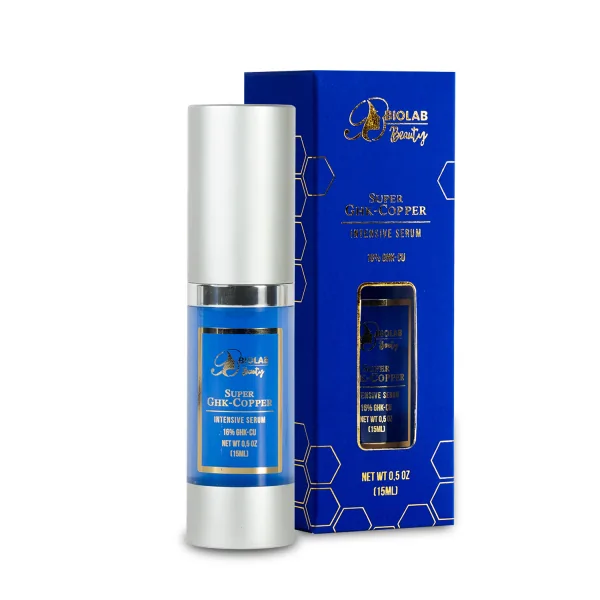
Products based on GHK-Cu combine copper peptide preparations used in specialist cosmetics and peptide care. This compound, also known as copper tripeptide-1, binds copper ions and appears in formulas discussed in relation to skin conditions, hair care, visible aging, regeneration and daily appearance care. The range includes copper peptide formats such as 20 mg and 50 mg options, a GHK-Cu peptide mix with Epithalon, peptide face creams for different skin types, and serum with copper peptides. This gives you several ways to approach the same ingredient, from standalone peptide preparations to finished skincare formulas. If you are checking “what is GHK-Cu?”, start with the form, declared amount and intended cosmetic context.
Comparing forms, sizes and product context
The GHK-Cu UK selection includes options that differ by format, amount and use context. Some customers look for a simple copper peptide preparation with a declared milligram value. Others prefer finished cosmetics, such as peptide face cream or serum, where the copper peptide is part of a broader skincare formula. These formats should not be compared only by price, because a 20 mg product, a 50 mg product and a 50 ml cream serve different purchasing needs. It is more useful to read the name, size, composition and notes together. Pay attention to:
- The declared amount or volume,
- The exact format,
- The ingredient list,
- Storage guidance,
- Availability and delivery status.
This keeps the comparison clear, especially when the page includes both peptide preparations and cosmetic products for skin or hair-related routines.
How to read GHK-Cu information before choosing
Useful GHK-Cu information helps you understand what you are adding to your basket without having to guess from the title alone. In this group, the most relevant details are the declared amount, volume, full composition, form, storage instructions and any available quality documents. For cosmetics, skin type also matters, because a cream for dry skin is not read in the same way as a lighter option for oily skin. For peptide preparations, the unit and naming convention carry more weight. The phrase what is GHK-Cu often appears when customers want a quick explanation, but the buying decision usually depends on the specification. A short label can contain several important clues, so it is worth reading beyond the first line. This approach gives you a cleaner comparison between copper peptide products, skincare formulas and mixed peptide options.
Laboratory verification and careful standards
We place strong focus on laboratory checks, composition data and practical documentation. Our work starts with ingredient selection, then moves through verification of concentration, purity and safety in cooperation with independent certified laboratories. For customers comparing GHK-Cu peptide products, this matters because peptide groups require more precision than standard wellness categories. The aim is not to make broad promises but to provide details you can verify before purchase. We have more than six years of experience in supplementation, and our products are made within the European Union. This is especially useful when comparing copper peptide options with different formats or compositions. Instead of relying on general claims, you can review the declared content, batch-related data, and available documents, then choose the option that best fits your intended use.
Choose the format that fits your routine
A clear choice starts with the format. If your focus is skincare, a serum or peptide face cream may be easier to place within an existing routine. If you are comparing standalone peptide preparations, the declared milligram value becomes more important. The GHK-Cu UK category also includes mixed options, so read the full product name carefully before adding anything to your basket. We list price, size and availability for each item, and 98% of orders are dispatched on the same day, keeping the buying process straightforward. This is helpful for customers interested in anti-aging care, skin, hair and nail-related routines, or specialist peptide categories. Review the form, composition and storage notes, then choose the GHK-Cu option that best matches how you prefer to shop. Compare the available products and select the one that fits your needs.
Do you know what you are looking for? Go directly to your preferred peptide among the most commonly used ones.
Where to buy GHK-Cu?
Buying research peptides requires clarity, documented quality, and a reliable source. BIOLAB operates as a specialised shop focused on laboratory-use compounds, offering GHK-Cu as part of a controlled, transparent product range. Every batch available in our shop is supported by independent laboratory analysis conducted at professional peptide and protein testing facilities. These analyses focus on real concentration data rather than only analytical purity, allowing researchers to work with precisely defined material. BIOLAB provides direct access to test reports originating from external laboratories. This approach removes uncertainty around composition and supports reproducibility in experimental work. Products are stored, packaged, and distributed under conditions suitable for laboratory reagents, with clear labelling and consistency across batches. The BIOLAB shop offers different formats and concentrations of GHK-Cu for experimental use. The offer remains consistent across the platform, with no changes to descriptions or claims between categories. This helps researchers compare materials and select the appropriate form for their protocols. BIOLAB builds its position through documented quality, continuous testing, and a broad product range dedicated to peptide research. The shop is structured for users who expect transparency, verified composition, and stable supply. Access the BIOLAB store to work with GHK-Cu, supported by published analytical data and controlled sourcing.
What is GHK-Cu?
GHK-Cu is a copper complex formed from the tripeptide Glycyl-L-histidyl-L-lysine and a divalent copper ion. Its structure allows stable chelation of copper through amino and imidazole groups, creating a compound suitable for controlled biochemical research. The defined molecular composition makes it a common reference material in studies involving metal peptide interactions. In laboratory settings, GHK-Cu serves as a model compound for examining copper binding, redox behaviour, and peptide-metal coordination. Its predictable structure supports use in spectroscopic analysis, chromatography, and mass spectrometry. Researchers rely on it as a benchmark when assessing the stability and behaviour of copper complexes in buffered solutions. The compound is also applied in experimental systems focused on protein synthesis regulation and extracellular matrix modelling. Due to its affinity for copper, it aids in the study of enzyme systems influenced by metal ions, including metalloproteinases and antioxidant enzymes. These properties position GHK-Cu as a practical research reagent rather than a theoretical construct. Because its chemical profile is well described, GHK-Cu is often selected for comparative studies that require reproducibility across laboratories. BIOLAB supplies this compound strictly as a laboratory reagent, in accordance with documented analytical standards and a consistent formulation.
What does GHK-Cu do?
In experimental research, GHK-Cu is used to observe how copper complexes interact with biological systems at a molecular level. Studies conducted in vitro and in animal models show that this compound influences enzymatic activity involved in protein turnover and extracellular matrix dynamics. Its presence affects pathways involved in collagen regulation, glycosaminoglycan balance, and structural protein synthesis. Laboratory data indicate that GHK-Cu modulates the activity of matrix metalloproteinases and their inhibitors, supporting controlled investigation of tissue remodelling processes. Researchers also use it to study redox reactions, as the copper ion in the complex participates in electron-transfer mechanisms relevant to oxidative stress models. In gene expression research, GHK-Cu has been used to analyse changes in genes associated with regeneration, inflammation mediators, and antioxidant defence systems. Experimental models show its role in signalling pathways linked to growth factors and cellular differentiation, including TGFβ- and IGF-related mechanisms. These characteristics make GHK-Cu a useful tool for structured laboratory studies focused on regeneration, fibrosis models, and metal-dependent biochemical processes. BIOLAB provides this compound for research use only, with concentration data that support precise experimental design and repeatable results.
The website is for informational and educational purposes only, and the products sold on it are intended for laboratory testing only. The authors of the texts are not responsible for the consequences of using the products, and users use them at their own risk. The site does not recommend or urge the use of its products on humans or animals.
Newsletter
Get a discount on your first order

Expert in supplementation and innovative health, fitness, and beauty solutions.

Offer
Offer Our company
Our company Contact
E-mail address
[email protected]
WhatsApp
+44 739 8562 456ⓒ 2026 Biolabshop. All rights reserved.
- Peptides Peptides
- Nootropics Nootropics
- Amino acids Amino acids